
"*" indicates required fields


Cleft Lip/ Palate in Dallas, TX
Cleft lip and cleft palate affect one in 700 babies annually. Parents of these children naturally want relief for their children, which they can find in a warm and caring atmosphere at the International Craniofacial Institute in Dallas, Texas.
Clefts vary greatly in degrees of separation, from little more than a slight indentation of the lip to a complete division/separation of the lip, nasal base, and hard/soft palate.
The condition’s various levels are named according to the placement of the cleft:
- Unilateral Cleft Lip/Palate – a cleft on one side
- Bilateral Cleft Lip/Palate – a cleft on both sides
- Cleft Palate Only – the cleft does not affect the lip or nasal base
At the International Craniofacial Institute (ICI) Cleft Lip & Palate Treatment Center, we do not see these variations in physical structure as abnormalities or deformities but as differences. All babies are unique – sometimes a child’s inherent differences are visible from the outside, sometimes they are not. A cleft lip/palate is simply one such visible difference – and it is repairable!
The oral-facial region is designed to carry out essential activities such as suckling, swallowing, breathing, sleeping, and crying. As a child grows, speaking, dental development, chewing and maintaining balance also become important roles of this area of the body. All these tasks are interrelated and are thus directly or indirectly dependent upon proper functioning of the mouth, nose, and/or ears.
A fully formed mouth and oral region allows breathing and eating to occur without confusing the two – an intact palate enables chewing without food going up the nose. Further, because the mouth is connected to the ears’ balancing and draining mechanisms, an intact palate helps ensure the critical inner ear muscles are properly connected to the inner ear mechanics. These connections allow an ear’s tiny Eustachian tube to sit at the proper angle, providing drainage and airflow. As the outlet for speech, the mouth and tongue rely on an intact palate to provide proper breath control and articulation required to create sounds. Incomplete closure of the lip, alveolus (dental ridge), and/or hard and soft palates (roof of the mouth) cause a baby with a cleft lip/palate condition to face challenges.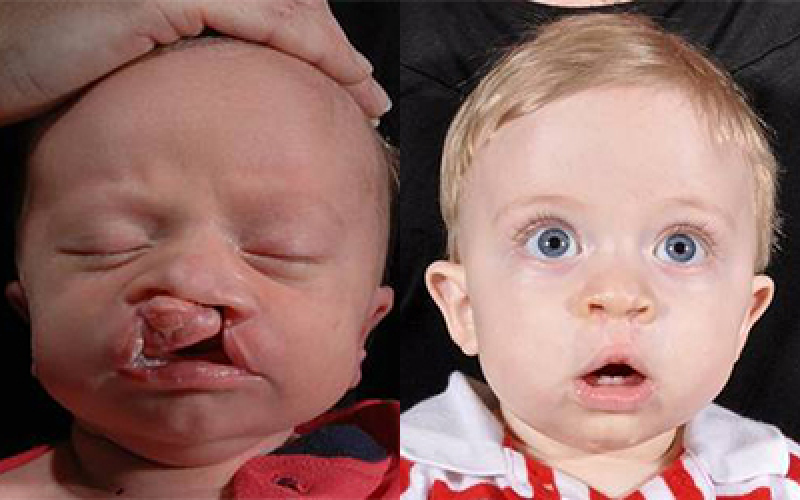

Click Here to read “Open Smiles” a book about someone born with a Cleft Lip and Palate, told from the point of view of one of our patient’s sisters.
We treat and correct cleft lip/palate and all its variations. International Craniofacial Institute performs more than 500 cleft lip and palate repairs each year, including all levels of complexity. Our team represents a wealth of specialization in every area related to cleft conditions. We work with each other, as well as with our patients’ loved ones, to ensure children born with cleft lip/palate become healthy, functioning members of their families.
Our commitment is to provide the best possible physical repair and reconstruction. As a result, you can expect two critical outcomes – proper function and a beautifully restored appearance of all cleft-affected areas. We’ll arm you with knowledge and caretaking skills while connecting you with people and resources to help each step of the way.
Why Choose International Craniofacial Institute?
Since its founding by Dr. Kenneth Salyer in 1971, the International Craniofacial Institute has gained worldwide recognition as being one of the most advanced facilities in the treatment of craniofacial disorders. The complexity of the field means we understand our patients have an array of dental, medical, psychosocial, and surgical needs. To address these issues, our team consists of many dedicated professionals who represent more than 15 disciplines of specialty. Our physicians have successfully treated more than 17,000 patients from more than 30 different countries. We additionally train surgeons from many world locations in the advanced techniques required for craniofacial diagnosis, surgical correction, and repair.
If you have a child or another family member who is suffering from a genetic syndrome or has a cleft lip, cleft palate, or craniofacial complication, the staff at the International Craniofacial Institute can help. Contact us today to talk with the doctors and staff about your options and how we can help.


