
"*" indicates required fields


Unilateral Cleft Lip/Palate in Dallas, TX
A unilateral cleft lip/palate affects only one side of the mouth and may be present in varying degrees. An accurate diagnosis followed by expert care from the highly skilled physicians of the International Craniofacial Institute can dramatically affect a child’s quality of life.
A unilateral cleft affects one side. It may be fairly minor (appearing as a small nick in the lip); extensive involving the lip, alveolus (dental ridge), and palate (roof of the mouth); or at a level between these two extremes. Below are the three major categories of unilateral clefts.
Unilateral cleft lip
This may involve just a part of the lip or the entire height of the lip.
The cleft may range from affecting the colored border of the lip only to extending up two-thirds of the lip height. The horizontal lip muscle may be divided only at the lower portion of the lip while the rest of the muscle and skin remain intact. Or the lip muscle may be divided completely, creating an open groove in the skin. Because the upper lip muscle is disconnected at the cleft, the segments may bulge on both sides of the separation.
Most often, unilateral cleft lip also affects the nose. The cleft lip’s separated muscles pull with an asymmetrical tension against the nostril on the cleft side, causing it to become larger with a more horizontal nostril as well. This pull also acts to shorten the central column of nose cartilage dividing the nostrils, causing the nose to be lower than usual.
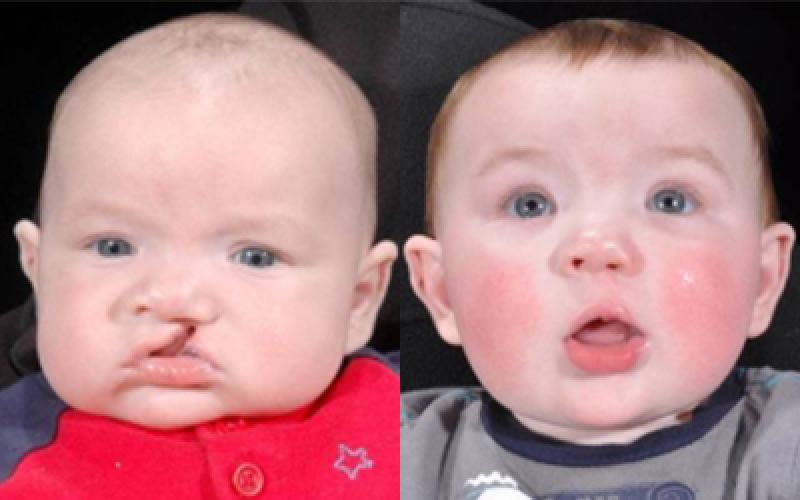
Unilateral cleft lip and alveolus (dental ridge)
This occurs when the upper lip and underlying dental ridge are each divided into two segments. The cleft may extend from the lip up through the floor of the nasal area – a “complete” unilateral cleft lip and alveolus – or it may affect only the lip and dental ridge.
The lip muscle is divided, creating an open groove in the skin and segments that may bulge on either side. The dental ridge is typically missing teeth and may have teeth that are crowded and/or rotated or abnormally shaped. The dental ridge perimeter may also form a narrower than normal arch.
Most often, unilateral cleft lip and alveolus also affects the nose. The cleft lip’s separated muscles pull with an asymmetrical tension against the nostril on the cleft side, causing it to become larger with a more horizontal nostril as well. This pull also acts to shorten the central column of nose cartilage dividing the nostrils, causing the nose to be lower than usual.
Unilateral cleft lip, alveolus (dental ridge) and palate (roof of the mouth)
This is similar to the unilateral cleft lip and alveolus, with additional complications from the open palate. The cleft opening is located not only on the lip and dental ridge but extends through the hard palate (sometimes back through the soft palate as well).
The extent to which the cleft continues toward the back of the mouth determines the level of correction and speech therapy required for accurate sound formation and clear speech. Often, the cleft results in teeth missing on the cleft side, being malformed or rotated, erupting into the palate instead of the ridge or some variation of these problems.
Why Choose International Craniofacial Institute?
The International Craniofacial Institute is one of the leading institutes for craniofacial disorders and conditions. Our doctors and surgeons have treated over 17,000 patients with genetic disorders worldwide. These disorders are most often centered on craniofacial issues, palate repair, and cleft lip repair. In addition to diagnosing and treating these issues themselves, the doctors and specialists also train other professionals from all over the world. The International Craniofacial Institute was founded by Dr. Kenneth Salyer, a surgeon, in 1971, and today it is headed by Dr. David G. Genecov.
If you have a child or another family member who is suffering from a genetic syndrome or has a cleft lip, cleft palate, or craniofacial complication, the staff at the International Craniofacial Institute can help. Contact us today to talk with the doctors and staff about your options and how we can help.


