
"*" indicates required fields


Hemifacial Microsomia Syndrome Treatment in Dallas, TX
Since 1971, the International Craniofacial Institute has served patients living with Hemifacial Microsomia syndrome from its offices in Dallas, Texas. Our primary goal is to create an individualized treatment plan for every patient’s unique case, therefore providing the best possible result.
What Is Hemifacial Microsomia Syndrome?
Hemifacial Microsomiasyndrome is a congenital disorder, meaning it typically begins at birth or in the first months of life. The disorder primarily affects the development of the lower part of the face, including the ears, mouth, and jaw area. Depending on the particular case, it may affect one or both sides of the face. In cases where the trachea is also affected, the disorder may also cause complications to breathing.
How Do People Inherit Hemifacial Microsomia Syndrome?
There is no evidence to clearly indicate that people actually “inherit” Hemifacial Microsomia. In most cases, Hemifacial Microsomia is caused by a trauma during the fetal stage of pregnancy. In other words, at around four weeks of the pregnancy, the child undergoes some difficulty in bringing blood to the areas of the face. The difficulty may be due to a problem in proper blood clotting. While current research has not yet determined any hereditary cause for the syndrome, some recent findings do indicate a possible genetic link.
How Common Is Hemifacial Microsomia Syndrome?
After Down syndrome, Hemifacial Microsomia is the most common congenital syndrome. After clefts, it is the most common birth defect of any kind. While statistics vary slightly, most estimates of the syndrome’s frequency put the figure at about 1 case per 3,500 to 4,500 live births.
Hemifacial Microsomia Syndrome Characteristics
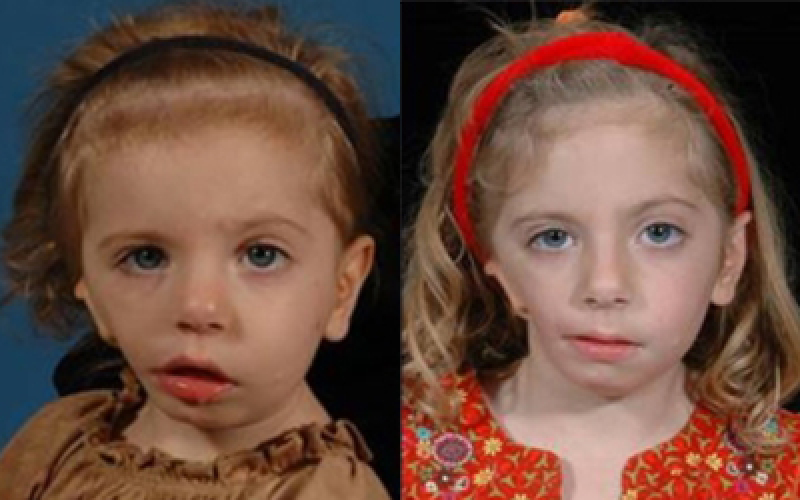
Hemifacial Microsomia is characterized by the underdevelopment of the lower jaw, the general underdevelopment of the lower area of the face, imbalanced development of the face from one side to the other, and/or underdeveloped inner and outer ears. In some cases, one eye might appear smaller than the other or even be missing completely. Some individuals may also have skin tags on the face.
What Is the Cause of Hemifacial Microsomia Syndrome?
The precise cause of Hemifacial Microsomia may be one of the several vascular problems that affect blood flow during pregnancy. Due to interrupted or faulty blood flow to the facial areas, the fetus begins to develop its face irregularly, with some areas growing at a slower pace. The specific cause of this vascular problem may be genetically informed, though research still has not determined any concrete links between genes and Hemifacial Microsomia.
Hemifacial Microsomia Syndrome Treatment
Treatment for Hemifacial Microsomia may involve surgeries, grafting, orthodontics, and hearing aids. The precise scope and timing of the treatment may vary widely, depending on the individual patient’s condition. Because Hemifacial Microsomia affects the growth and development of the face from birth, it is vital to appropriately time any operations in concert with the individual’s growth. Changes to the facial structure send “messages” back to the body and can indirectly influence future growth. Therefore, in treating Hemifacial Microsomia, the medical team must carefully analyze the structures and growth patterns of each individual patient.
Why Choose International Craniofacial Institute?
The International Craniofacial Institute in Dallas, Texas is a leading institute for the accurate diagnosis and quality treatment of Hemifacial Microsomia syndrome and other syndromes and conditions. Our institute was founded in 1971 by Dr. Kenneth Salyer, a surgeon. Today, the institute is organized and led by the director, Dr. David G. Genecov. Dr. Genecov operates the International Craniofacial Institute as one of the nation’s most prestigious centers for palate repair, craniofacial repair, and cleft lip repair.
At our institute, we train doctors and surgeons from all over the world. In addition, our doctors have treated more than 17000 patients. These patients come from the United States, as well as other countries.
To alter and correct craniofacial abnormalities and difficulties, a high skill set is demanded, and we have that here. Our doctors, surgeons and the rest of the staff are extremely knowledgeable and always up to date on the newest methods of diagnosis and treatment. Among all of our employees, we have decades of experience working with different syndromes, including Hemifacial Microsomia syndrome.
If you have a child or another family member who is suffering from a genetic syndrome or has a cleft lip, cleft palate, or craniofacial complication, the staff at the International Craniofacial Institute can help. Contact us today to talk with the doctors and staff about your options and how we can help.


