
"*" indicates required fields


Muenke Syndrome Treatment in Dallas, TX
Parents with children who are born with a rare condition known as Muenke syndrome naturally have lots of questions that not all doctors are able to answer. These parents can find answers to their questions and hope for a successful recovery by visiting the International Craniofacial Institute in Dallas, Texas.
What Is Muenke Syndrome?
Max Muenke was the first to notice and diagnose Muenke syndrome in 1996. Muenke syndrome is the result of the closing of the baby’s side skull sutures. During gestation, a baby’s side or coronal sutures may close early, which can ultimately cause Muenke syndrome.
How Do People Inherit Muenke Syndrome?
Nothing the mother or father does before or during pregnancy causes Muenke syndrome. Rather, the syndrome is caused by a genetic mutation. When parents do not have the syndrome themselves, there is a slim chance of them having a child with Muenke syndrome. On the other hand, if one of the parents has Muenke syndrome, the chances of them bearing a child with Muenke syndrome is about 50 percent.
How Common is Muenke Syndrome?
Muenke syndrome is not very common at all. In fact, Muenke syndrome occurs in approximately only 1 in every 30,000 births.
Muenke Syndrome Characteristics
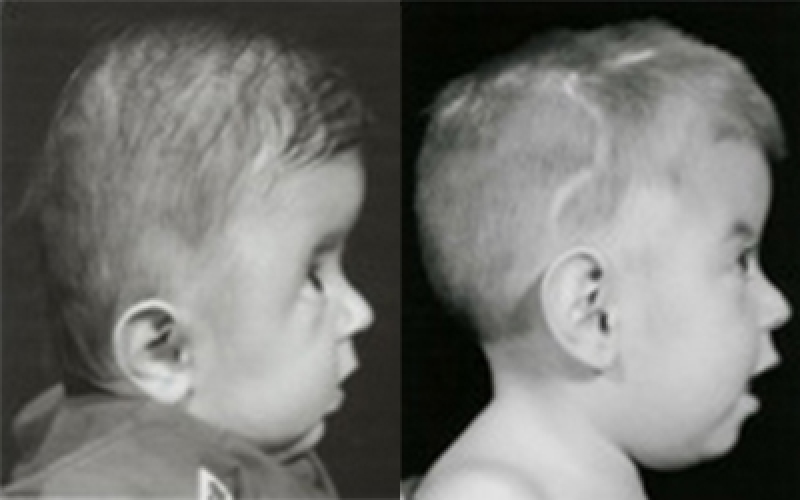
There are several key characteristics of Muenke syndrome that doctors and specialists work with at the International Craniofacial Institute. First, the individual will have an unusually shaped head with a flat looking area in the middle of the face. In addition, hearing loss is common in individuals who have Muenke syndrome. These individuals tend to have eyes that are especially wide set. They may have small defects in the feet, toes, hands, and fingers as well. Finally, in approximately 5 percent of the Muenke syndrome cases, the individuals have enlarged heads.
What Is the Cause of Muenke Syndrome?
Sporadic gene alteration is the cause of Muenke syndrome and many other syndromes like it. In the case of Muenke syndrome, the genes that are responsible for protein production and cell growth regulation are affected. Bone growth is interfered with, and skull sutures fuse prematurely before Muenke syndrome manifests.
Muenke Syndrome Treatment
Treatment of Muenke syndrome and other genetic mutation syndromes like it vary from syndrome to syndrome and patient to patient. This is true, even though, many of the syndromes share the same traits and causes. The abnormal growth patterns will continue throughout the individual’s life because they were put in place before the individual was even born. This means that ongoing issues and complications can develop and change throughout the life of the individual. We will be able to treat these changes over time. Some of the treatments offered for Muenke syndrome include mid-face advancement, release of skull suture fusion, and eye surgery.
Why Choose International Craniofacial Institute?
The International Craniofacial Institute in Dallas, Texas is a leading institute for the accurate diagnosis and quality treatment of Muenke syndrome and other syndromes and conditions. Our institute was founded in 1971 by Dr. Kenneth Salyer, a surgeon. Today, the institute is organized and led by the director, Dr. David G. Genecov. Dr. Genecov operates the International Craniofacial Institute as one of the nation’s most prestigious centers for palate repair, craniofacial repair, and cleft lip repair.
At our institute, we train doctors and surgeons from all over the world. In addition, our doctors have treated more than 17000 patients. These patients come from the United States, as well as other countries.
To alter and correct craniofacial abnormalities and difficulties, a high skill set is demanded, and we have that here. Our doctors, surgeons and the rest of the staff are extremely knowledgeable and always up to date on the newest methods of diagnosis and treatment. Among all of our employees, we have decades of experience working with different syndromes, including Muenke syndrome.
If you have a child or another family member who is suffering from a genetic syndrome or has a cleft lip, cleft palate, or craniofacial complication, the staff at the International Craniofacial Institute can help. Contact us today to talk with the doctors and staff about your options and how we can help.


